CFG's policy experts, Richard Sagar and Isaac Bristol, provide an overview of all the relevant announcements from the Chancellor's Autumn Budget.

Even by the low standards of recent budgets, this one had almost nothing directly relevant to charities. There were more mentions of Dolly Parton than of charities or civil society in the Chancellor’s speech. However, there was a collection of small pots of funding available for specific causes, as discussed below. The overall sentiment from many economic commentators was of a budget with many small changes announced, without changing anything fundamentally, and largely sticking to a path set by his predecessors to reassure the bond market. The Treasury will have kept a close eye on the bond markets to see how they respond to the budget, but at the time of writing it has not noticeably impacted gilt yields, which will be a relief to all concerned.
Given the ongoing conflict in Iran, or what the Chancellor called ‘global economic storms’, there is enormous uncertainty surrounding the OBR’s forecasts, so they should be taken with an even larger pinch of salt than normal. Spending £14bn more on debt interest will be of concern, as will historically low rates of growth over the next few years, with GDP growth forecast to rise by only 1% next year. Fiscal headroom has also been reduced from £23bn to £15bn to help mitigate some of the economic effects, specifically arising due to the conflict in Iran. As the Chancellor said, “That is what a buffer is for - use it when you need, rebuild it when you can.” But as the Institute for Fiscal Studies has commented "This will leave the Chancellor with less scope to absorb bad news in the future."
The key announcements in today’s budget didn’t have much direct impact on the sector. The planned removal of standing charges on domestic gas bills from 2027 (with these fixed costs instead paid through the unit rate) might offer some respite to households, saving around 60% of households with gas accounts an average of £45 per year. This is alongside an additional £100 energy payment this winter for households in council tax bands A–D in England. However, while these measures are primarily targeted at households, charities whose electricity supplies already qualify for the reduced 5% VAT rate will also benefit from the temporary 0% rate, which the budget has extended until July 2027. While welcome, this relief is unlikely to do much to ease the significant financial pressures charities face from rising energy costs.
This is also largely true for the flurry of announcements from HM Treasury in the run up to the budget: on the Carer’s Allowance taper instead of cut-off point, parental pay extended to self-employed fathers, removing import tariffs on a selection of goods (though changes to the cost of gherkins will likely have a limited impact on charities’ bottom lines), tax-free mileage allowance, first time buyer ISA amongst many others (please see more details in the briefing below). Whether these announcements provide the ‘breathing space’ on the cost of living that the Chancellor set out to provide is still far from clear, but we will get a stronger indication of the impact over the coming months.
The additional £442m investment to prevent rough sleeping will be welcome news to homelessness charities (meaning total additional rough sleeping funding will reach £874m between 2026–27 and 2028–29), as will the £5m a year for three years to increase the provision of books for pre-school children, supporting organisations like the Books Trust and Dolly Parton’s Imagination Library. These are alongside £15m for the Office for the impact Economy to support women and girls and underpin the work of the National Taskforce for Tackling Misogyny. But these were piecemeal interventions and there was no vision for civil society and charities as a whole.
The 3.9% increase in the national minimum wage and National Living Wage will further increase operating costs for many charities, particularly those working in care and related areas which have high levels of staffing. It is unclear whether grants and contracts will increase correspondingly to account for these additional costs. This is a major concern for the sector, and we would have hoped to see further progress.
Many announcements do also have relevance for the charity sector, even if they are not directly linked in the Chancellor’s speech or the Red Book. One announcement linked directly to an ask we made ahead of the budget for greater support with AI adoption, although it is unclear whether the government’s announcement applies to charities. We will push the government to ensure that our sector can benefit from this funding.
Looking beyond this budget, the upcoming spending review will be crucial for the sector, as it will set out spending commitments for years ahead. This will also put detail on the Prime Minister’s forthcoming Ten Year Plan. CFG, alongside sector partners, will seek to influence these key statements of direction and policy, to try to help charities and the beneficiaries they serve.
For a full list of the relevant policy changes that impact charities, see the detailed briefing below.
Please complete our survey to share your thoughts on how the budget will impact your charity
OBR forecast and economic data
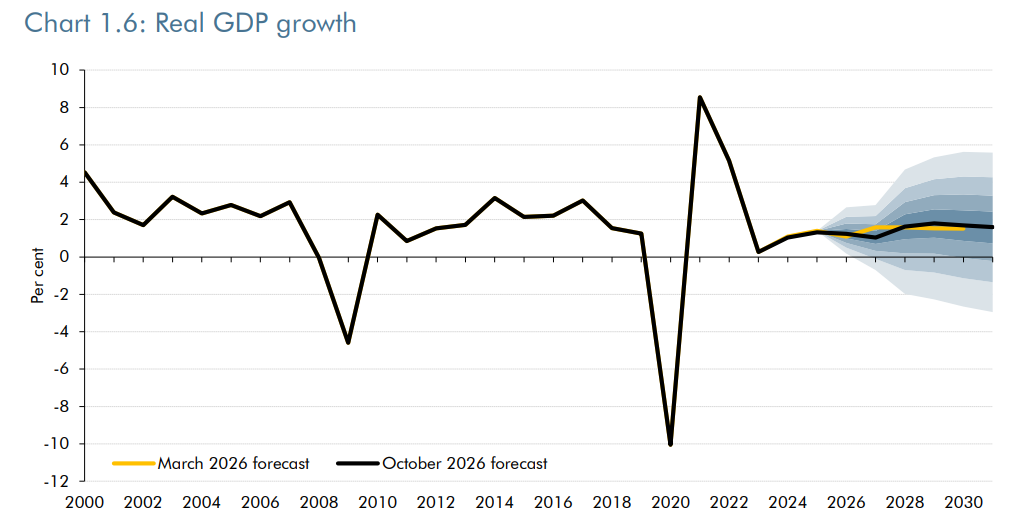
Real GDP growth
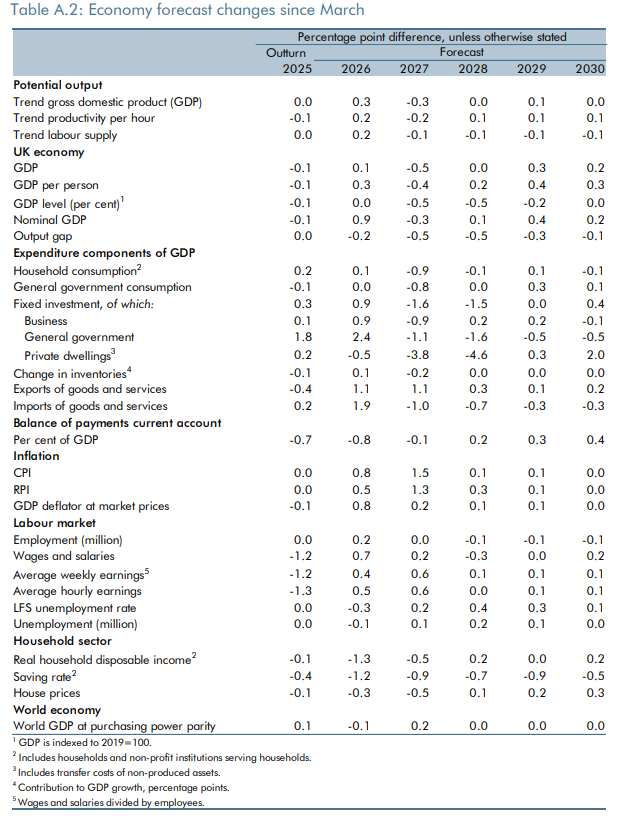
Often mentioned by the government, the UK has been the fastest-growing economy in the G7 so far this year. However, growth remains relatively weak, forecast at around 1.25% in 2026 and 1% in 2027, before recovering to an average of 1.75% annually over the remainder of the forecast period.
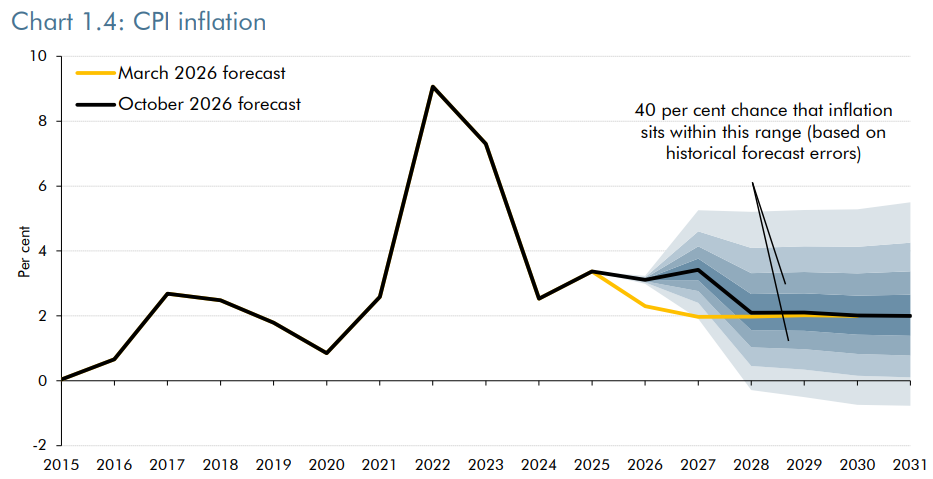
CPI inflation
CPI inflation is forecast to rise to a quarterly peak of 3.75% in early 2027, with inflation in 2027 expected to be 1.5 percentage points higher than forecasted in March, unsurprisingly driven largely by rising energy costs.
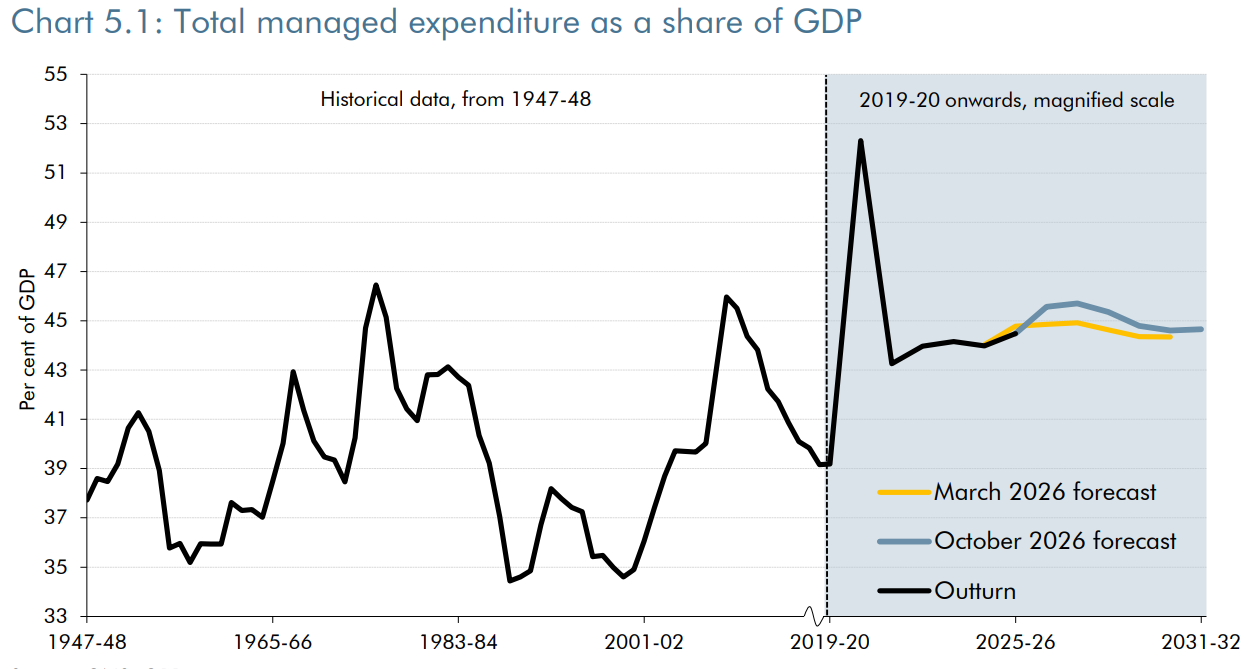
Managed expenditure as a share of GDP
Public spending as a share of GDP is forecast to be higher than was anticipated in March 2026, particularly in the near term, driven largely by higher debt interest payments and welfare spending.
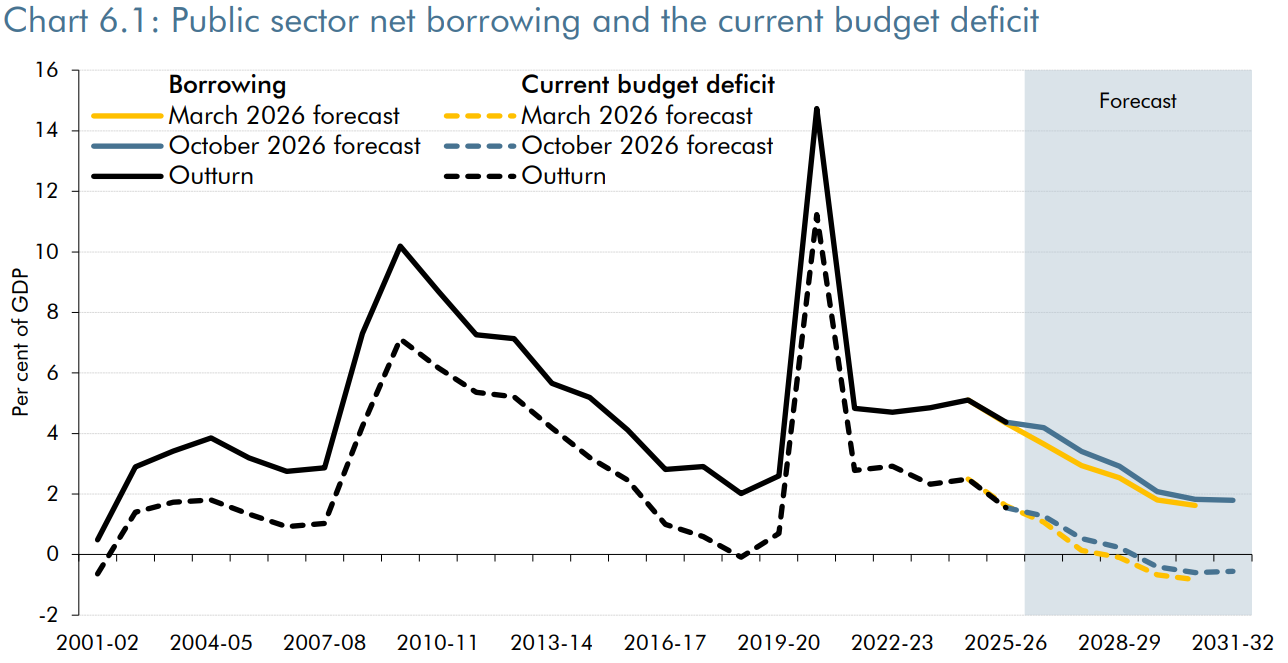
Public sector net borrowing
Public sector net borrowing is expected fall slightly to 4.2% (£133bn) in 2026-27. It is then forecast to decline steadily, reaching 1.8% of GDP by 2030-31. Although borrowing is now expected to be higher than forecast in March, the overall downward trend remains broadly consistent with the November 2025 forecast, which anticipated borrowing falling to 1.9% of GDP by 2030-31.
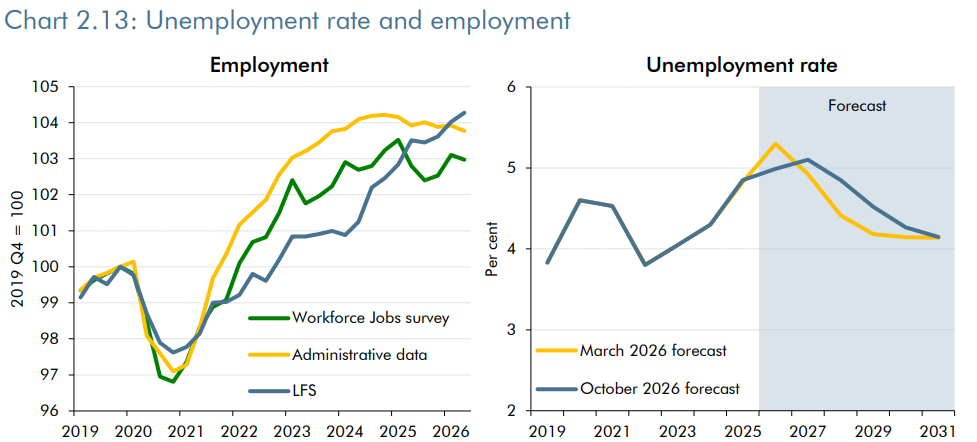
Unemployment and employment rate
The loosening labour market is becoming an increasingly difficult challenge for the Government, with falling job vacancies and subdued employment growth. Unemployment is expected to peak at just above 5% in the second quarter of 2027, broadly in line with March's forecast, although the peak is now expected to occur a year later.
Real earnings growth
The challenges in the labour market, alongside higher inflation, have also contributed to a weaker outlook for real earnings growth. As the OBR forecasts, real earnings are expected to see no growth in 2027 and 2028, before recovering modestly to around 0.5% annually by 2030.
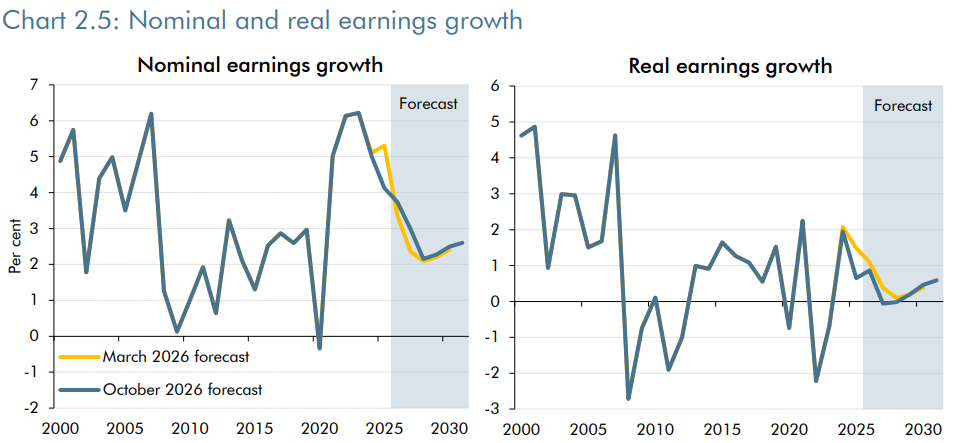
Table A.1: Economy Forecast
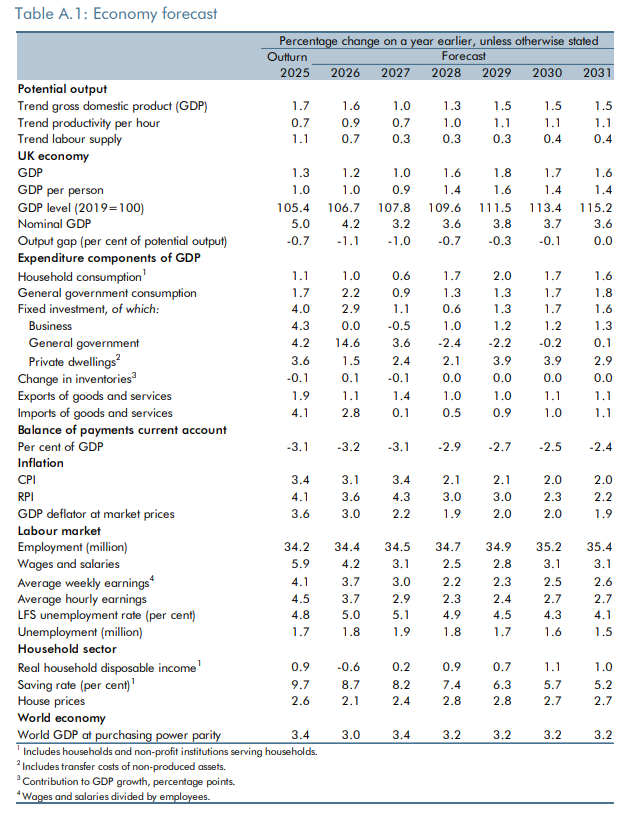
Table A.2: Economy forecast changes since March
Sector 'asks' ahead of the Budget
Ahead of the budget, the Civil Society Group wrote to the Chancellor to consider measures that could be implemented to help support the charity sector. These included:
- Ensuring government grants, contracts and procurement processes fully recognise and fund the true cost of delivering services, including full cost recovery, multi-year funding arrangements and inflationary uplifts;
- Encouraging charitable giving and long-term philanthropy by modernising Gift Aid and protecting tax incentives that support charitable donations and legacy giving;
- Supporting place-based giving initiatives and local voluntary sector infrastructure to attract new donors and strengthen communities;
- Investing in community ownership through a long-term national strategy and increased funding for community assets;
- Helping charities adopt digital technologies and AI safely and effectively through dedicated support and investment;
- Strengthening cyber resilience across the sector through practical support, funding and improved access to cyber security expertise.
While these proposals were not enacted at this budget itself, there was positive news on additional funding for community assets and ownership. However, the funding announced falls far below the proposals put forward in our budget submission. We will continue to work with the government to push for changes that will improve the financial position of the charity sector at the upcoming Spending Review and as part of the forthcoming Ten Year Plan.
Welfare
Welfare: removal of benefit entitlements from serious offenders in hospital – From 6 April 2027, individuals convicted of a number of serious offences who are detained in hospital will no longer be entitled to benefit payments in Great Britain. Overall, this is expected to save around £5 million in 2031-32.
The government looks forward to the final reports of the Milburn and Timms reviews, and this Budget confirms that the government will set out its responses before the end of this year. A White Paper will follow early in 2027 ahead of legislation later that year.
Universal Credit: surplus earnings threshold – The government will maintain the surplus earnings threshold at £2,500 for Universal Credit claimants in Great Britain for a further year until the end of March 2028.
Parental pay: establish a parental allowance for fathers, partners and adopters – The government is extending parental pay to eligible self-employed fathers, partners and
adopters in Great Britain from April 2029. Those who are recently employed or unemployed, or with a broken or irregular pattern of employment, and therefore do not qualify for statutory paternity or adoption pay will also benefit providing that they have sufficient work and earnings history.
Carer’s Allowance: introduce a taper on excess earnings – The government is replacing the cliff edge withdrawal of Carer’s Allowance at the Weekly Earnings Limit with a 100% taper on earnings in excess of the limit. The taper is planned to be introduced in 2030-31 and apply in England and Wales.
Offsetting Child Benefit overpayments – HMRC will automatically offset Child Benefit overpayments against the High Income Child Benefit Charge (HICBC), simplifying administration for affected customers by reducing unnecessary payment and repayment transactions. This will be introduced through legislation in Finance Bill 2026-27 with retrospective effect from HICBC’s introduction in January 2013.
DWP fraud and error: increase preventative checks in Pension Credit – The government will provide prompts to Pension Credit claimants to redeclare the correct amount of capital they hold.
DWP fraud and error: invest in 2,000 specialist fraud staff – The government will recruit over 2,000 specialist fraud staff in DWP to prevent fraud in new and existing Universal Credit claims.
DWP fraud and error: clamping down on welfare fraud for those living abroad – The government will strengthen DWP’s ability to identify cases where customers remain abroad longer than benefit rules allow.
DWP fraud and error: Universal Credit advances – The government will restrict access to a repeat New Claimants advance to claimants where previous New Claims Advance debt remains. Appropriate exemptions will be applied to protect those in exceptional circumstances.
Sector specific announcements
Rough sleeping – Over July and August, the Prime Minister announced £442m of funding to deliver a route off the street to rough sleepers in England before Christmas, alongside longer-term accommodation and intensive support. The government is now announcing additional funding to ensure that people sleeping rough in England have a route off the streets, not just this year, but every year, taking total additional rough sleeping funding to £874m from 2026-27 to 2028-29.
Supported housing licensing scheme – The government is introducing a licensing regime in 2027-28 to enforce national standards for supported housing in England
Social and Affordable Homes Programme uplift – The government is providing further funding of £1.5 billion for the Social and Affordable Homes Programme, taking total capital investment in social and affordable housing to more than £40 billion over 10 years. This will complement the £9.6 billion allocated earlier this year and support delivery of around 10,000 additional homes.
Books for children – The government will provide £5 million a year for three years from 2027-28 to increase the provision of books for pre-school children, supporting organisations such as the Dolly Parton Imagination Library and BookTrust.
Misogyny prevention funding – The government will provide £15 million to the Office for the Impact Economy to work with businesses, investors and philanthropists to mobilise additional funding to support women and girls, and underpin the work of the National Taskforce for Tackling Misogyny, chaired by the Minister for Women and Equalities.
Procurement
Procurement reform– A new National Procurement Policy Statement will be laid in Parliament in March 2027, prioritising delivery of high-quality jobs, fair pay and skills opportunities. The government will publish a new definition for a “UK supplier” in public procurement by January 2027, to get a better understanding of UK suppliers and sub-contractors across public supply chains. The government has published new guidance on applying social value in central government procurement, and is using procurement to proactively shape strategic markets.
The government has published new guidance on applying social value in central government procurement. Businesses bidding for major government contracts will be judged on their commitment to creating high-quality jobs, tackling local skills shortages, and supporting young people into work. Guidance on using PPN 026: The Social Value Model (HTML) - GOV.UK
While the greater emphasis on social value is potentially welcome, particularly for charities supporting employment and skills development, it remains unclear whether these changes will translate into greater opportunities for charities to secure public contracts. The changes also do little to address the sector's longstanding concerns about inadequate contract funding. CFG will continue to push for procurement processes that recognise the full cost of delivering services, including inflationary uplifts and multi-year contracts.
Pensions
Income Tax: Pension Tax Allowance – The government will introduce the Pension Tax Allowance (PTA), ensuring that pensioners whose total income is up to the value of the full new State Pension do not have the administrative burden of paying small amounts of tax. The value of the PTA is calculated by applying the basic rate of income tax (20%) to the difference between the full new State Pension and the Personal Allowance. Individuals over State Pension age are eligible for the automatic tax deduction if their income, regardless of source, is below or at the value of the full new State Pension. For those with incomes just above the value of the full new State Pension, the allowance will be gradually withdrawn through a taper. The allowance will apply from 6 April 2027 until 5 April 2030 and will be uprated in line with the full new State Pension across this Parliament. It will be legislated for in Finance Bill 2026-27 and the government will consider arrangements beyond April 2030 in the usual way.
Guided Retirement and Retirement Collective Defined Contribution pension schemes – The government will make changes to enable the consolidation of Defined Contribution schemes and the introduction of the Guided Retirement framework and Retirement-only Collective Defined Contribution (RCDC) pension schemes. This will include expanding the circumstances when a member may keep certain protections following a transfer and allowing members to transfer from an RCDC pension to a drawdown arrangement within a set timeframe. This will be introduced through Finance Bill 2027-28.
Alongside the policy announcements above there was a further commitment to amend the triple lock after April 2029:
"Alongside reform of working-age welfare, the government has announced plans to put the State Pension on a sustainable footing for the decades ahead, giving people confidence that a rising State Pension will be there for them when they retire. In line with the government’s commitment to the Triple Lock throughout this Parliament, the State Pension will continue to rise by the highest of 2.5%, inflation or earnings growth each year through to April 2029. This is set to see the annual rate of the full new State Pension increase by more than £2,000 over the course of the Parliament, taking the State Pension to a record high relative to earnings. The government is committed to delivering a sustainable State Pension system that people can trust will rise every year and be available for current and future pensioners. That is why the government is making those gains permanent by adjusting the Triple Lock from April 2030 so that the State Pension rises each year by the highest of 2.5%, inflation, or the amount required to maintain its value relative to earnings as reached in April 2029.
This adjustment will generate significant savings to help build up a high-quality, preventative National Care Service in England that will provide older people with personal care free at the point of use. To help prepare for these changes in the next Parliament, the Prime Minister has agreed with Baroness Casey that her Independent Commission on Adult Social Care will now report in 2027.
This is a new settlement for older generations. A sustainable footing for the State Pension will ensure it remains a cornerstone of retirement incomes for future generations. Alongside this, the Pensions Commission’s final report will be published in February next year and recommend steps to ensure the private pensions system delivers retirement outcomes that are adequate, fair and sustainable"
NLW/NMW
National Living Wage and National Minimum Wage – On 1 April 2027, the National Living Wage will increase by 3.9% to £13.21 per hour; the National Minimum Wage will increase by 3.9% to £11.27 per hour for 18 to 20-year-olds and by 3.9% to £8.31 per hour for 16 to 17-year-olds and eligible apprentices; and the accommodation offset will rise by 3.9% to £11.53 per day.
For charities that employ workers on the National Minimum Wage and National Living Wage this will increase operating costs at a time that they can ill afford it.
Official Development Assistance (ODA)
Official Development Assistance (ODA) update – The government remains committed to restoring ODA spending to 0.7% of Gross National Income (GNI) as soon as the fiscal circumstances allow. The OBR’s latest forecast shows that the ODA fiscal tests are not due to be met within the Parliament. The government will continue to monitor future forecasts closely and, each year, will review and confirm, in accordance with the International Development (Official Development Assistance Target) Act 2015, whether a return to spending 0.7% of GNI on ODA is possible against the latest fiscal forecast.
There will be continued disappointment amongst INGOs that ODA spending is unlikely to reach 0.7% of GNI at any point during the course of this parliament, as ‘the fiscal circumstances’ do not allow it. It is deeply disappointing for the government to continue with these fiscal tests which deprioritise increasing the aid budget.
Community Asset and Ownership
Community assets and ownership – The government will provide an additional £65m to help communities across England rescue and renovate buildings and businesses at risk of closure, including pubs and sports clubs. A further £125m Derelict Buildings Fund will support English local authorities to transform unused buildings into facilities that meet community needs
These announcements are welcome and potentially support the sector’s proposal for greater investment in community ownership and local assets, but further detail will be needed on how charities and community organisations can access the funding. We would also hope to see a longer-term strategy aligned with the asks in our budget submission.
Preventative Departmental Expenditure Limits (PDEL)
The government recognises that placing greater emphasis on early intervention can yield benefits in the long term and help to address the drivers of poor outcomes and cost. The government is committed to acting to address problems before they escalate, improving people’s lives and delivering better long‑term value for taxpayers.
To support this approach, the government will introduce a new category of ringfenced spending at the spending review in 2027, preventative DEL (PDEL). PDEL will help facilitate shared resource and accountability across budget holders, and will help protect programmes that generate benefits over the longer term.
This could be a welcome development for charities delivering preventative services, particularly in areas such as health, social care and homelessness. However, it remains unclear whether this will translate into additional funding for charities. CFG will seek to ensure that the sector is recognised as a key partner in delivering preventative services and benefits from this new approach to public spending.
AI
Building on the Law Commission’s product liability consultation, the government will consult next year on how to tackle insecure technology at source and consider where liability for cyber breaches should sit.
£30m to pilot local partnerships, starting with West Yorkshire Combined Authority, South Yorkshire Mayoral Combined Authority, and York and North Yorkshire Combined Authority to develop locally led approaches to AI adoption. Building on the experience of Barnsley, the UK’s first Tech Town, these will work across local councils to help small businesses grow, equip people with the right skills, and transform local public services.
AI Pathfinder fund – £60m of funding will be provided between 2026-27 and 2029-30 on a needs-led basis to test solutions to cross-government barriers and opportunities arising from the AI transition.
Local AI partnerships – The government will provide £15m funding for Local AI partnerships to pioneer place-based approaches to AI adoption from 2026-27 to 2029-30.
National Agentic Security Unit – A new £40m National Agentic Security Unit will build world-first capabilities to detect and respond to misaligned agentic activity, increasing resilience to agentic incidents.
National Cyber Shield – A new £60m National Cyber Shield will develop agentic capabilities to automate the UK’s cyber defences, including a £25 million AI and Cyber Security Challenge Fund to foster UK innovation.
AI NERV centre – A new £70m National Exposure and Real-Time Vulnerability (NERV) Centre will deploy AI tools to identify cyber vulnerabilities across our critical infrastructure and the wider economy.
While these announcements do not mention charities and civil society directly, they are of relevance. Working with the Charities AI Taskforce we would hope to see charities as part of the consultation process for some of these schemes, particularly the local AI partnerships to boost place-based AI adoption.
We would also like to see additional funds made available to help charities adopt digital technologies and AI safely and effectively through dedicated support and investment, and for cyber resilience to be strengthened across the sector through practical support, funding and improved access to cyber security expertise.
Tax
While overall there is very little of relevance to our sector regarding tax, a lack of fundamental changes does offer a degree of stability which to an extent is to be welcomed. However, we would still like government to go further and consult on, and implement, plans to digitise Gift Aid and make this important relief fit for the future.
E-invoicing – The government will require VAT invoices to be issued in a specified electronic format from 1 April 2029. The government has published an implementation roadmap, which sets out the key elements of the e-invoicing regime, and by April 2028 will provide full details on the policy and technical design of e-invoicing. The government has also published a consultation on potential future uses of structured invoice data generated through e-invoicing.
Tax Update event – The government will announce further measures to simplify and modernise the tax and customs system at a Tax Update in 2027.
VAT zero-rate for donated medicines – The government will introduce a new zero-rate of VAT for medicines donated in qualifying circumstances, including through early and expanded access schemes. The zero-rate applies to qualifying donations made on or after 23 June 2026.
Temporary VAT zero-rate on electricity –The temporary 0% VAT rate for domestic electricity (six months from 1 October 2026) will be extended for a further three months, to 1 July 2027. This is expected to apply UK-wide from April 2027.
Requiring direct debit arrangements for VAT and PAYE return liabilities – The government will require taxpayers to set up a direct debit instruction for VAT and PAYE return liabilities from April 2029. Businesses will continue to be able to use other payment methods to pay their liability before a specified cut-off date. The direct debit instruction will be used to collect any unpaid balances.
Fuel duty: 2027-28 main rates – The government will extend the temporary 5p-per-litre fuel duty cut for a further six months to 1 July 2027. The government is also deferring the planned RPI inflation increase to 1 July 2027.
Writing down allowances – The government will introduce legislation in Finance Bill 2026-27 to increase the main rate first-year allowance to 50% for expenditure incurred on or after 1 January 2027 and to reduce the main rate writing down allowance to 12%, with effect from 1 April 2027 for Corporation Tax and 6 April 2027 for Income Tax.
Mileage rates review – As announced on 27 October, the government is permanently increasing tax-free mileage rates for employees and self-employed people who use their own car or van for work. The tax-free, per mile rate will be 55p for the first 10,000 miles and 35p per mile for mileage above 10,000 miles.
Zero-rate on land sold to social housing providers –The government will implement a zero-rate of VAT for land sold to registered providers of social housing (relevant Housing Associations). This will be introduced through secondary legislation in early 2027 and take effect from 1 April 2027.
Revert to reduced rate on energy saving materials (ESMs) as planned and include heat batteries in scope – The government will add heat batteries to the list of materials that qualify for the reduced rate of VAT of 5% applying to energy saving materials from 1 April 2027, when installed in residential accommodation and charitable buildings. This will be legislated for via secondary legislation and take effect from 1 April 2027.
This is one of the few charity specific announcements in the budget and accompanying documents and builds on previous work CFG and others undertook to include certain energy saving materials as qualifying for the reduced rate of VAT of 5% for charitable buildings. While this not a significant change it could be of some benefit to charities looking to install heat batteries.
Vehicle Excise Duty (VED) exemption for search and rescue vehicles – At Budget 2025, the government announced that search and rescue charities will receive an exemption from VED for eligible vehicles. The government will introduce legislation for the exemption through the Finance Bill and it will come into effect from 1 April 2027.
While this is not a new announcement, it confirms the legislative timetable of the previously announced exemption for search and rescue vehicles.
Landfill Communities Fund (LCF) value – The government will increase the cap of tax credit claimable by landfill operators in respect of contributions to the LCF from 5.3% to 8.3% of their Landfill Tax liability, to help sustain the LCF and support local communities.
This is a welcome announcement for charities and community organisations that benefit from LCF funding, supporting environmental projects, community facilities and other local initiatives. However, it remains to be seen how much additional funding will be made available to charitable projects.
Business Rates
Business rates: Small Business Rates Relief thresholds for Retail, Hospitality and Leisure (RHL) – The government is increasing the SBRR eligibility thresholds for qualifying RHL properties in England from 1 April 2027. The threshold for 100% relief will increase to a rateable value of £18,000, and the threshold for tapered relief will increase to a rateable value of £21,000. These thresholds will provide ongoing support to qualifying properties, with their level kept under review alongside the 2029 revaluation.
Business rates: freeze bills in real terms for RHL properties for two years – The government will ensure that business rates bill increases for qualifying RHL properties in England are capped by CPI inflation in 2027-28 and 2028-29. This does not apply to increases in rateable values resulting from improvements, or losses in other reliefs such as improvement relief or hardship relief post 1 April 2026.
Business rates: Transitional Relief Supplement (TRS) – The government is extending the 1p TRS for two years from 1 April 2027. This will be paid each year by those seeing bill increases otherwise below the Transitional Relief and SSB caps.
Business rates: Valuation Tribunal removal of appeal fees – The government will abolish the £150 and £300 fees charged by the Valuation Tribunal in England for non-domestic rating appeals. This will apply to the 2026 rating list and future lists and will enable fees already paid for appeals on the 2026 list to be refunded.
Business rates: relief for pubs, social clubs and live music venues – The government is increasing the relief for pubs, social clubs and all but the very largest live music venues in England by 20ppt, from 15% to 35% from 1 April 2027. The very largest live music venues (with a rateable value of £1 million or above) will not receive this increased rate of relief, but will continue to benefit from the previously announced 15% relief in 2026-27 and real-term freeze in 2027-28 and 2028-29, as announced in January 2026. This will provide ongoing support to qualifying properties, with the level kept under review alongside the 2029 revaluation.
Devolution
Publishing the Fiscal Devolution Roadmap – The government is publishing the Fiscal Devolution Roadmap, which sets out its plans to reform the way that regional government is funded. This includes bringing Mayors into the Business Rates Retention system from 2027-28 and providing them with a share of income tax from 2028-29, as well as enabling strategic authorities to introduce visitor levies with local leaders able to set out plans for how revenues will be invested by March 2028.
Confirming progress towards new devolution agreements – The government confirms it is in the final stages of agreeing new devolution agreements with 10 areas. Final arrangements will be confirmed in due course, subject to agreement with local areas.
Increasing Business Rates Retention as part of fiscal devolution – From April 2027, mayors will receive a share of business rates income in exchange for Investment Funds, Mayoral Capacity Funding and Local Growth Funds, alongside a 20% share of growth in their areas on a permanent basis.
Business Rates Retention Zones programme for Mayoral Strategic Authorities – Subject to Full Business Case approval, the government is supporting nine Strategic Authorities by establishing new Business Rates Retention Zones. Within these zones, the relevant billing authorities can retain 100% of business rates growth above an agreed baseline for 25 years, allowing them to invest in local priorities.
Good Growth Funds – The government is supporting Mayors and local leaders in England to establish Good Growth Funds, giving local leaders greater flexibility to invest in local growth priorities with £285m in transitional seed funding for one year in 2027-28, accompanied by a devolved borrowing facility for MSAs of £1.5 billion from April 2028 to catalyse investment into regional growth priorities. This facility will include a mechanism for subsidised lending.
Local Renewal Fund – The government will continue to support local projects across the UK through a new £80m Local Renewal Fund to invest in local economic regeneration, support job creation, maintain heritage assets and back local initiatives that boost economic growth.
Youth employment and skills: expanding local apprenticeship services to all current mayors – The government is providing £100m of funding across 2027-28 and 2028-29 to expand Mayoral Apprenticeship Brokerage Pilots from 7 to 14 Mayoral Strategic Authorities across England. This will enable all current mayors to provide tailored support to young people and employers, particularly SMEs, to create more apprenticeship opportunities.
These measures could create opportunities for charities delivering employment support, skills training and youth services.
CFG’s view
CFG’s Co-CEO, Clare Mills comments:
"We welcome the small steps the Chancellor has taken in his first budget to alleviate some of the pressures faced by millions of people up and down the country. Help with rising energy costs and a repeat of the commitment to ending rough sleeping will make a positive difference to people and families who often have only charities to support them.
Charities meeting these and other needs, across the whole of the UK, are working under real strain, with growing demand, rising costs and, often, reduced income. Apart from some changes to the National Minimum Wage and National Living Wage, this budget did not introduce major new costs for charities.
However, as CFG and the Civil Society Group outlined prior to the budget, there were many low-cost steps the government could have taken to ease pressure on the sector. Though the government has made efforts to work more closely with charities through the Civil Society Covenant, charities and civil society barely featured in the Chancellor's speech, despite the significant and vital role the sector fulfills in supporting the Government's missions and contributing to the much-mentioned ‘good growth in every postcode’.
We will continue to work to secure closer engagement between the sector and government, ahead of the announcement of the Prime Minister’s Ten Year Plan and next year's spending review. The Prime Minister has focused on a preventative agenda for addressing some of the biggest challenges facing society, and civil society has a huge wealth of expertise and innovation to support that approach."
Reactions from CFG's corporate partners
Andrie Kazamias, Tax Director, RSM UK:
The budget provides welcome certainty for charities and not-for-profit organisations, with no significant changes to key charity tax reliefs or Gift Aid. In an environment where many organisations are under increasing financial pressure, stability in the tax regime will be welcomed.
The government’s further progress towards tax digitalisation should help to modernise administration and compliance over time in the sector.
The government's commitment to protecting pensioners will be welcomed by many charities whose beneficiaries depend on the state pension. Plans to introduce an adjusted triple lock from 2030 intended to maintain pension value relative to earnings while improving long-term sustainability could be helpful to the sector for future funding.
Charities play a critical role in supporting older people, disabled people and vulnerable communities, often where public services are stretched. As demographic pressures continue to build, the sector will have been hoping for greater clarity and support to meet this growing demand, which they didn’t receive in today’s budget.
While this budget delivers certainty on tax, the bigger question is whether investment in charities and not-for-profit organisations will keep pace with the increasingly important role they play in society.
Sarah Garnish, consultant, Quantum Advisory:
It is clear that the new pension tax allowance has been put in place by the government to protect low-income pensioners whose sole income is the state pension. There does however remain questions on this new policy as this approach will become costly quickly. The government needs to also be careful that this approach does not disincentivise low-income individuals saving for a private pension.
James Bird, senior consultant and actuary, Quantum Advisory:
It has been evident based on various studies in recent years that the cost of the triple lock is unsustainable. In light of this the proposal to move to a double lock appears a sensible move, particularly given the intent to use the funds to benefit pensioners elsewhere. The weakening of the state pension does however bring further into focus significant upcoming pensions adequacy issues over the next 20 to 30 years.”
Kerri McIvor, Investment Manager, Quilter Cheviot:
The latest budget brings another increase in staffing costs for a charity sector already under significant financial pressure. From April 2027, the National Living Wage will rise by 3.9% to £13.21 an hour, equivalent to an additional £910 a year for a full-time employee. For a charity employing 50 full-time staff at this level, that could mean approximately £45,500 in additional basic salary costs alone, before considering employer national insurance or pension contributions.
For employees facing continued cost-of-living pressures, this is welcome; however, it creates further pressure on charities already managing stretched budgets. Many of their main sources of income, including grants and donations, may not keep pace with rising employment costs. With no direct funding boost for the voluntary sector announced alongside these higher wage costs, organisations may therefore face difficult choices about where to reduce spending.
That could mean freezing recruitment, reducing staff hours or delaying projects. Others may need to draw more heavily on reserves to bridge the gap. Ultimately, this risks reducing charities' capacity to help people at precisely the point when cost-of-living pressures may increase demand for their services.
On a potentially more positive note, the government's “good growth in every postcode” agenda may create opportunities for charities involved in supporting local communities and regeneration. The £100 energy payment will also provide some welcome support for household finances and may ease some of the pressures driving demand for charitable services. However, with wider living costs remaining elevated, this is unlikely to significantly ease the challenging environment facing many frontline charities.
For trustees, the challenge is therefore not only how to meet today's rising costs, but how to do so without compromising the charity's ability to support future beneficiaries. Where reserves are increasingly needed to maintain essential services, balancing the needs of today's beneficiaries with protecting resources for tomorrow becomes even more important.
Richard Tidball, Partner - Tax, Forvis Mazars
Whilst there were relatively few changes to tax rules applying specifically to charities and non-profit organisations in the 2026 autumn budget, the Chancellor’s speech did
contain several measures that will impact the sector. Charities continue to face the combined pressures of increased demand for services, constrained funding and rising employment and operating costs.
In particular, increases in the National Living Wage and National Minimum Wage by 3.9% will increase staffing costs for many charities. This is likely to be felt most keenly by labour-intensive organisations, including those operating in social care and community services, where there may be limited ability to pass additional costs on to service users or funders. Employers adopting the Real Living Wage will be impacted by a more sizeable increase of 4.8%, as announced by the Living Wage Foundation prior to the budget, coming into force by 1 May 2027.
There were, however, some positive announcements for the sector, including welcome support on energy costs. The budget extends the VAT reduction on electricity until July 2027, alongside wider measures intended to reduce electricity costs. Although these measures are not specific to charities, they should provide some relief to organisations facing significant energy and premises costs.
There are also changes to business rates, including additional support for qualifying retail, hospitality and leisure properties and specific measures for pubs, social clubs and live music venues. These changes may benefit some charitable and community organisations, although the interaction with existing charitable business rates relief will need to be considered.
Housing charities and housing associations may particularly benefit. An additional £1.5bn is being made available for social and affordable housing, while from 1 April 2027, land sold to registered social housing providers will benefit from a new VAT zero rate. This should reduce VAT costs on qualifying land acquisitions, although as ever the detailed conditions of the relief will be important.
Welfare reform is also likely to have a significant knock-on effect for charities and their beneficiaries. Measures include a Jobs Guarantee for eligible 18 to 24-year-olds on Universal Credit, changes to Carer's Allowance and reforms intended to address the financial disincentives to work for people living in supported and temporary accommodation. Further changes to disability and health-related support are also expected.
More broadly, the budget signals a greater emphasis on preventative and locally delivered public services. For charities already delivering services in areas such as health, housing, employment and community support, this could create further opportunities to work with government and local authorities.
Overall, while there is little direct change to the fundamental taxation of charities, the budget contains a mixture of targeted support and wider measures that will affect both charities themselves and the people they support. Energy measures, business rates changes and targeted VAT reliefs provide some positives, but for many charities the central challenge will remain managing increasing costs while demand for their services remains high.