An organisation’s culture lies at the heart of everything it does, including the way it thinks about and manages its financial resources. In this three-part series, Simon Perks explores how charities can better understand their financial culture, and how this understanding can drive financial awareness and accountability.

Organisational culture is notoriously difficult to define. It’s invisible. It’s intangible. And it makes itself known in ways that are often hard to fathom. But for something that has given rise to so many books, articles, webinars and podcasts, organisational culture is remarkably simple. It’s nothing more than the way we do things around here.
It is, nevertheless, hugely important. Because an organisation can only do what its culture will allow it to do. In a battle between culture and strategy (or, indeed, between culture and anything else), culture will win out every time. Furthermore, all organisations have their own unique culture. Even if it’s not the one they’d like to have.
Promoting financial awareness and accountability
In these financially straitened times, the organisation’s culture in respect of its financial resources is especially important. It drives the way people across the organisation think about, relate to and manage money. And so we need to make sure that our financial culture is a positive one. One that promotes financial awareness and accountability.
A culture of financial awareness and accountability doesn’t, however, just happen. It needs to be created, nurtured and sustained. But it’s not a question of simply rolling out a training course or exhorting people to be financially aware. Culture goes deeper than that. And so we need to understand what makes our financial culture what it is.
My favourite approach to understanding organisational culture – financial or otherwise – is the cultural web. It’s a model that was developed by management professors Gerry Johnson and Kevan Scholes. And since I stumbled upon it several years ago, I’ve used it to help unlock profound insights into financial culture across all kinds of organisations.
Understanding culture with the cultural web
The cultural web is made up of six elements, which collectively embody the essence of an organisation’s culture:
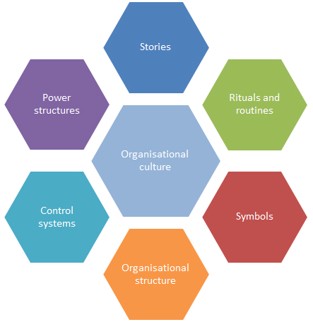
- Organisational structure: This is what the organisation chart says. It’s about hierarchies and roles. It’s about who reports to whom, who makes the decisions, which teams sit where and how everything all fits together.
- Power structures: This is how things actually work. It’s about influence, relationships and authority. It’s about who has the ability to get things done, regardless of where they appear on the organisational chart.
- Control systems: These are the formal mechanisms used to govern and manage the organisation. The rules, procedures, systems and processes. The ways in which the organisation allocates resources and monitors performance.
- Rituals and routines: These are the things we do without really thinking about it. From the annual budget-setting process to the preparation of monthly management accounts. From weekly team meetings to annual performance reviews.
- Symbols: Symbols are visual representations of how the organisation and its people see themselves. It includes ‘formal’ things, like the organisation’s logo and brand assets. But also less formal symbols like dress codes, office layouts and the coffee in the kitchen.
- Stories: Stories are the things people tell each other and outsiders about the organisation. They’re the things we remember when we’ve forgotten everything else. The myths, anecdotes and legends that become part of organisational lore.
Creating and nurturing a positive financial culture
Understanding your organisation’s financial culture allows you to identify the things that really make a difference in the ways your people think, act and behave. But the real challenge is to create, nurture and sustain a culture that sits in alignment with your organisation’s financial goals, values and aspirations. Because this is where the real benefit is to be found.
In the next two articles in this series, we’ll look at how you can use the cultural web to do just that. We’ll explore what each of the six elements means for us in practice and how we can use them to create a culture of financial awareness and accountability. Because the organisation’s financial culture is the foundation upon which everything else is built – and it’s important to get it right.
For Simon's full series exploring organisational and financial culture, read part 2 and part 3.