What are the impacts of your investments? Janie Oliver, Chief Financial Officer at Stewardship, shares a framework for impact that puts your most important goal at the centre of investment.
The landscape of the investment environment in the UK has been changing significantly over the past few years.
With the spotlight on world-changing issues, like the climate crisis, racial justice and gender equality, conversations around the responsibility of investors have become prevalent. Decisions around what to resource, when, and to which level of risk are increasingly important.
Stewardship is a Donor Advised Fund (DAF) and, true to our name, we continually ask ourselves whether we are being good stewards of our growing assets. How should we be thinking about the entirety of our assets as a tool to achieve our mission and our charitable objectives, not just the grants that are made out every year? How do we make sure we do aggregate good, and avoid harm? How do we encourage our donors to think about some of these questions?
The explosive growth of the Donor Advised Fund market as the UK’s fastest growing philanthropic giving vehicle over the past few years has brought this into even sharper focus. For example, we have seen a 40% growth in our balance sheet over the last two years, following the trend of an increase in philanthropic giving.
When the assets are invested before they are granted out, they have tremendous potential for sustained and increased impact, and as a DAF we have a responsibility to create opportunities to invest in more meaningful and impactful ways. We have created an investment framework that puts these questions at the centre of achieving the impact we would like to see.
An Impact Framework
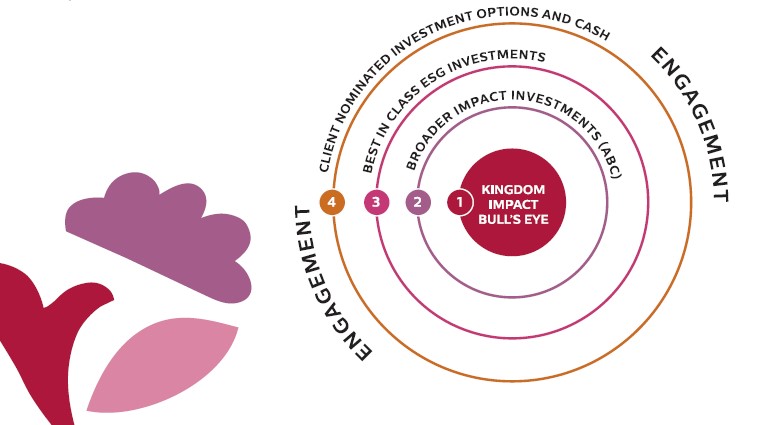
We are inspired by the thinking of other influential organisations in this space such as Access – The Foundation for Social Investment. They have developed a framework known as the bull’s eye approach. It asks the primary question – what is the impact that our investments seek to generate? Tiers are then created in relation to the decided impact, with the most important goal at the centre.
As a Christian organisation, our ambition is that the Bull’s Eye investments (Tier 1) are aimed at directly achieving what we refer to as ‘Kingdom Impact’ – namely investments in organisations devoted to supporting and building Christian ministry and resourcing the Church.
We’ve also slightly expanded out the bull's eye concept to ‘Broader Impact Investments’ (Tier 2) acknowledging that those investments seeking to positively address the UN Sustainable Development Goals are in line with how our faith compels us to act.
The next tier of investments (Tier 3) seeks to invest in ‘Best in Class ESG investments’ and finally, having exhausted those three categories within our investment universe, remaining investments will either be in cash (other than deposits held at ethical banks which are classified in Tier 1 or 2) or in other client-nominated options that do not fall into the other three tiers.
While our investment framework may be relatively new, Stewardship’s heart for impact is not. We’ve been lending to churches and charities for over 30 years, and 2021 was a record year for our lending activity, with £10.2m of new loans made to churches and charities.
We see this as a vital part of both our mission and our investment portfolio. In many cases, we have provided a loan, when no other lender has been willing to support a church, which generated both significant kingdom impact as well as financial return.
As well as continuing to look within the mainstream market for investment opportunities, we hope to be able to help shape and create investment opportunities where we see options to expand the inner bull’s eye (Tier 1).
In 2020, we led a consortium of Christian investors to purchase Kingdom Bank to ensure its future as the only UK bank focused on serving Christian churches and church workers and enable Christians to invest their savings with a missional focus in the work of the Church.
We are excited to continue exploring new opportunities where mission and return intersect and multiply the impact of our
mission through investments that deliver social and kingdom impact. This journey will continue into 2022 and beyond and we’re looking forward as to how this will challenge, grow us, and scale the impact we’re able to achieve.
This article was first published in Bates Wells' 'Faith-based Organisations Update 2022'. Reproduced with kind permission from Bates Wells.