After spending a significant period of time working with various charities, we have found the hidden secret behind successful charity finance teams: finance data architecture. Iain Goldmann, partner at Cloud Doing Good, explains.

As partners providing enterprise resource planning solutions, we often have conversations with charity finance teams at the point when they have decided that their system is no longer working.
While it often is the case that there are better systems for them, we have also noticed a trend.
Too often, the system is blamed for a problem that actually starts elsewhere. The problem, in fact, usually begins with the metadata.
The challenge of metadata
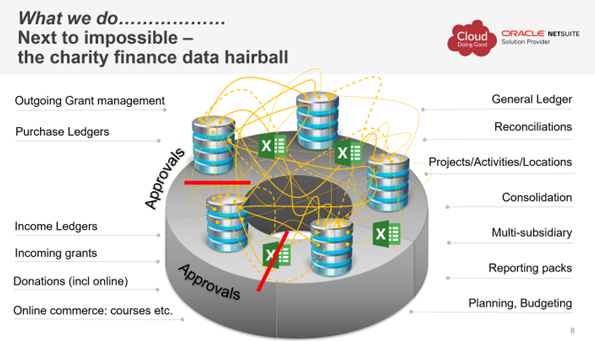
Metadata is complex in the charity context.
Very often, a charity needs to tie accounts payable (outgoing sums/sub grants/activities) to account receivables (incoming sums/funders/restricted/unrestricted).
Meanwhile, there are external reporting requirements (restricted/unrestricted, funder reporting) that require material levels of accountability between accounts payable and accounts receivable.
This often leads to a complex range of different metadata held in different systems, sometimes spread out across various locations around the globe.
By the time the problem makes it to us, we hear that there are different numbers on different reports or even that your organisation’s data is too complex to run reports on.
However, if you don’t focus on the data architecture first, this problem will only duplicate itself in whatever system you choose next.
The challenge of customisations
Most organisations try to manage this maze of data architecture through customisations. Sometimes this means configuring existing ERPs – and reconfiguring, and reconfiguring again.
At other times, that means creating highly specific, new reports to reconcile all the different data fields.
After going down this road for a little while, the customisations can even feel comforting or necessary for your organisation.
Your team works hard to deliver for your charity’s mission, and the configurations you have come up with function to a certain extent, so why take the time and energy to fix what isn’t completely and horribly broken?
The solution: single source of truth data
The truth is that shaky data architecture and complex workarounds cost your organisation.
Endless configurations to your ERP turn your finance experts into a pseudo-IT team. Custom report upon custom report upon custom report mean that when someone is out on holiday, you can’t pull up the data you need to make the decisions to empower your organisation.
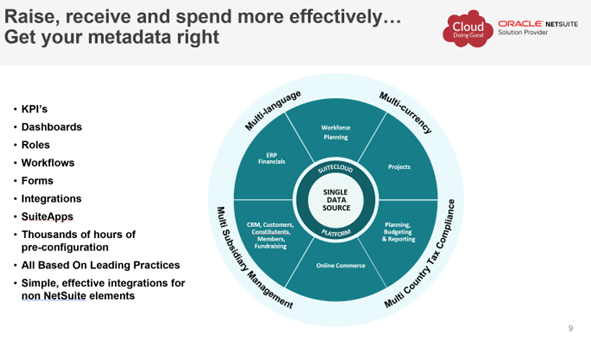
That is why – even beyond choosing a new ERP – it is so crucial to move to the Single Source of Truth (SSOT) data model.
You’ll set up one single data source where all your data lives. Then, every other part of your financial planning and reporting integrates into that data source with the single metadata model.
Time savings: adopt, not adapt
When stuck with multiple data sources, your team has had no choice but to adapt, adapt, and keep adapting as needs changed.
It can be tempting to look at any new system for data architecture and see all the ways your team would configure it to meet each of your specific needs.
Instead, consider the ‘Adopt, Not Adapt’ strategy. Work with your ERP to discover the established data best practices for charities across the platform, and implement those best practices for your team.
From there, you can adapt if necessary. However, starting with this strategy allows your organisation to restart your data architecture according to industry best practices, instead of carrying over the problem from your old system into your new one.
Our goal is always to empower organisations so they can have the maximum social impact as possible. That means identifying the problem where it begins, instead of assuming the problem is the existing system.
After helping many charities transform the financial planning systems, we have seen how important it is to commit to creating a sturdy data architecture to ensure the success of your team.
Cloud Doing Good is Oracle-NetSuite’s EMEA Social Impact specialist partner, working exclusively with the ‘Suite Success Adopt not Adapt’ methodology. Here is a 2.5 minute who we are explainer video.