Part one: You need to make your organisation more resilient but where to start? In his step-by-step guide, Robin Aitken begins by exploring some tools for assessing the resilience of your organisation.
In this series, I will be exploring steps that the leader of a charity finance team can take to assess and build the resilience of their organisation, as well as considering personal resilience and how people can find ways to protect themselves in difficult times.
In this article, I suggest a framework for assessing the strength of your charity’s finance function and how you can use this to build resilience. This is a starting point from which different elements will be explored in more depth.
The resilience framework
I find the framework, shown below, a useful way to analyse the resilience of a finance function:
|
People
|
Processes
|
Strategy
|
Technology
|
Information
|
Funding
|
|
Competence
|
Definition
|
Existence
|
Management
|
Structured
|
Adequacy
|
|
Capacity
|
Control
|
Suitability
|
Security
|
Analysis
|
Income generation
|
|
Culture
|
Compliance
|
Awareness
|
Embraced
|
Presentation
|
Diversity
|
|
Connections
|
Relevance
|
Buy-in
|
Relevance
|
Use
|
Engagement
|
|
Confidence
|
Up-to-date
|
Risk management
|
Refresh
|
Accuracy
|
Informed by strategy
|
By scoring each individual element on a five-point scale outlined below, a finance team can work out which areas of activity need attention, agree where to focus their efforts to build resilience and improve their performance.
Assessment: method for scoring
Each of the 30 elements of the resilience framework can be scored on the following five-point scale:
| Score |
|
|
1
|
Non-existent
|
|
2
|
Inadequate
|
|
3
|
Emerging
|
|
4
|
Developing
|
|
5
|
Mastering
|
Areas needing attention which have lower scores (say a score of 2 or fewer) can then be analysed further to prioritise the work required to improve resilience using the following 2x2 matrix:
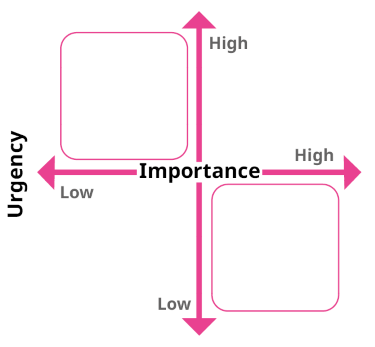
Areas with high importance and high urgency will be the ones to address first, with the rest of the analysis providing a basis for discussion of where else to move forward.
How to use
I would recommend that:
- These analytical tools are used with a degree of appropriate playfulness – have fun!
- They can be drawn on flipcharts with sticky post-it notes placed on them.
- As far as possible, try to involve the whole team, although there maybe occasions when you might simply want to draw up an analysis on your own.
- Differences of opinion can be useful, providing an opportunity for members of the team to learn from each other.
- You canvas opinions from people outside the finance team who know you and/or rely on your services.
- Don’t be afraid to change the framework: if an area is missing that you think should be there, add it; likewise feel free to remove areas or change how they are described to suit you and your organisation. This is a tool for you to use as you see fit.
- Once the analysis is done, come to a considered view of what is most important, and how and when you are going to take action – the output should be a development plan with SMART objectives.
- Share the analysis and action plan once it is complete with your team and the leadership group of your organisation. This will help you commit to taking action and hold you accountable to make changes.
- Once you have started with a baseline analysis, in order to monitor what progress you are making repeat the exercise regularly at, say, quarterly intervals.
- If you feel that you could benefit from an independent view or need more resource to carry out the analysis reach out to an outside consultant or resource who can help facilitate the work, challenge your thinking and write things up.
An ask: please can you provide your feedback?
I hope that you find this initiative to help build resilience of interest. The plan is that this is the first in a series of articles and other materials (e.g. webinars or self-help groups) that will explore the subject of resilience in more depth, digging into specific areas of activity shown on the framework, as well as examining ways to develop personal resilience for you and your team.
Please can you let me know:
- What interests you more: ways to build resilience of the finance function as a whole; building personal resilience; or both?
- What do you think of the framework? How useful could it be for you?
- What areas of the framework would you like to hear more about?
- How would you like to hear more about this subject: more online articles; webinars; a face-to-face conversation?
- Would you be interested in setting up a peer-support group to work with to share and discuss ways to develop resilience? If there is sufficient interest we will see if we can help you set this up.
- Anything else that you think is worthy of comment.
I am fascinated to learn how you feel about this subject and these tools! Please email me your thoughts and insights.