How can your charity remain financially sustainable during the cost of living crisis? Dan Fletcher from Moore Kingston Smith explains the importance of understanding your business model and what your costs and funding gaps really are.
There are typically three main business models that charities follow. Clarity on this is the first step in ensuring your charity can be sustainable.
- Fundraising charities rely on philanthropic support to provide services that create social value.
- Service delivery charities are commissioned to provide services under contract.
- Social enterprise charities generate income through selling goods and services, often at a premium because their customers are happy for them to invest any surplus back into delivering social value.
Charities can of course operate as hybrid versions of two or all three options, and this often creates challenges due to the differing priorities across the models.
Whatever model, it is crucial to know the actual costs of delivering each service and decide how general costs and overheads are fairly apportioned. These apportionments can be somewhat arbitrary, and strategic decisions need to be made about how to recharge costs and how to be transparent.
Mind the (cost-recovery) gap
To be sustainable, this transparency must apply both internally and externally. Charities need to be clear about their funding gap to either sign it off or change their course of action.
Charity leaders also need to be transparent with funders about the true cost of their work. We often find that charities struggle to do either. This may be due to a lack of clear financial data or an inconsistent approach from one funding bid to the next.
Once the costs are clearly defined and allocated, it is possible to measure the cost-recovery gap between income and expenditure and to plan how to close and fund the gap. How you do this depends on your business model.
- A fundraising charity needs to understand the value of subsidy required to cover the gap to make a clear case for support.
- A service delivery charity needs to know what level of costs to include in tenders to decide how viable a contract is, or whether it will cost more to deliver a contract than will be received in income.
- A social enterprise needs to be sure that its sales prices are sufficient to create a surplus so that it has resources to spend on doing good.
For hybrid models, it is even more important, as a surplus from social enterprise activity may, for example, be being used to supplement shortfalls in contract income.
Being able to talk transparently and factually about a funding gap is important both internally and externally. It is crucial to closing that gap and being more financially sustainable.
Don’t forget about impact
We can’t just talk about the money side of charity programmes without considering the impact they create. While any gap between income and expenditure does need to be closed, you can’t base a decision about investment in or divestment of charitable activities purely on the financials.
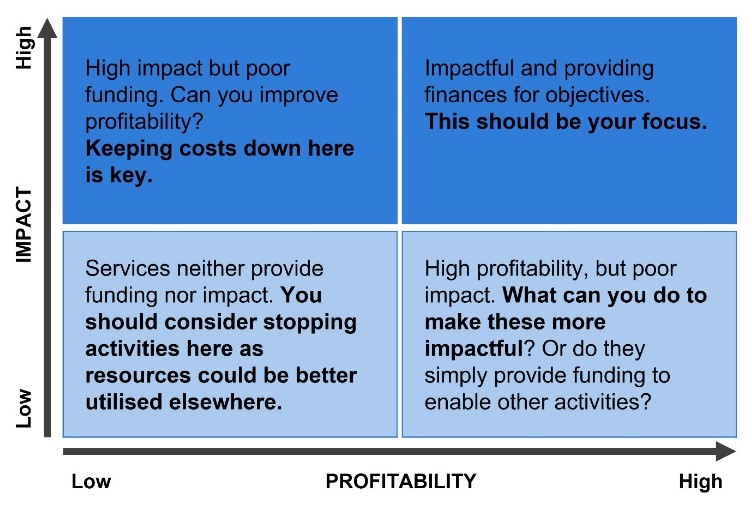
We use a decision-making tool that plots the level of impact of each service against its financial sustainability. In an ideal world, every service area would create high impact and be financially sustainable. Some services, however, are high impact with poor financial sustainability.
Others may have had their day and be low impact and poor financial sustainability. There may even be some services that are financially sustainable but create low impact.
Plotting your portfolio on this 2 x 2 grid, with each activity’s direction of travel and relative importance, will create a visual decision-making tool to help you prioritise where to make changes.
In summary, understanding your underlying business model is critical for future financial sustainability. But to make the best decisions about future financial strategies, it is essential to consider impact and to think with both your financial head and your social heart when assessing the viability of your services.