Ruth Jenkins, Finance Director at environmental charity Keep Britain Tidy, talks about her transformative net zero work and shares the ‘easy wins’ she believes will go a long way to protecting all our futures.

Keep Britain Tidy is more than a charity dedicated to picking up litter – its three aims are ‘to eliminate litter and end waste, improve the quality of public space and inspire people to live more sustainably’.
It was with these goals in mind that its Finance Director, Ruth Jenkins, seized the opportunity to lead on the charity’s work to improve sustainability and move the organisation towards net zero.
As well as being a chartered accountant with a Master’s degree from Bayes Business School, Ruth is a committed environmentalist.
She has more than 20 years’ experience working in and for the charity sector and is proud to have introduced the option for Keep Britain Tidy staff to join the UK’s first net zero pension scheme.
Ruth is now on a mission to share what she’s learned with other charities so that the sector can work towards net zero – and help secure a brighter future for all.
I spoke to Ruth about the changes she’s spearheaded and where Keep Britain Tidy will go next on its net zero journey. And I ask her why she believes that the not-for-profit sector must now take its net zero responsibilities seriously in a race to survive and thrive.
Hi Ruth, please tell us about Keep Britain Tidy and your finance team
‘Keep Britain Tidy’ originated from a resolution passed by the Women’s Institute nearly 70 years ago. Over the decades, we’ve been supported by everyone from ABBA and The Wombles to Marc Bolan and Kirstie Allsopp.
Alongside litter, our work has expanded to advise on recycling and waste minimisation, improving green spaces, and our Eco-Schools work helps pupils green their schools.
Our vision encompasses all that the WI wanted in their initial resolution: A clean and healthy environment, rich in wildlife and valued by people who ‘Love Where They Live.’
There are three of us in the finance team (2.6 FTE). Plus, four more across core in IT, HR and fundraising (3.3 FTE). We have about 60 staff and more than 400,000 people volunteer with us every year.
How are you and the team involved in moving Keep Britain Tidy towards net zero?
We know what we do with our money has a huge impact on our carbon footprint, so we look to improve pensions and banking. Our HR policies can make a big difference, so we have climate-friendly travel policies and plant-based catering policies.
We provide training for staff on the interlinked climate and biodiversity crises. We set up the Green Group and have secured an Eco-Audit for the charity.
When did this work start and why? What’s the evidence that suggests this is an emergency?
Three years ago, I completed a four-part training session with AimHi.Earth – an incredibly accessible and helpful programme for giving you the facts about our climate change predicament and clear steps to act to improve it.
I knew it was important to share this across our staff group, so we ran the training in our all-staff meetings over the year. If we don’t all understand the context, we can’t be sure to choose the right actions for our programmes going forward.
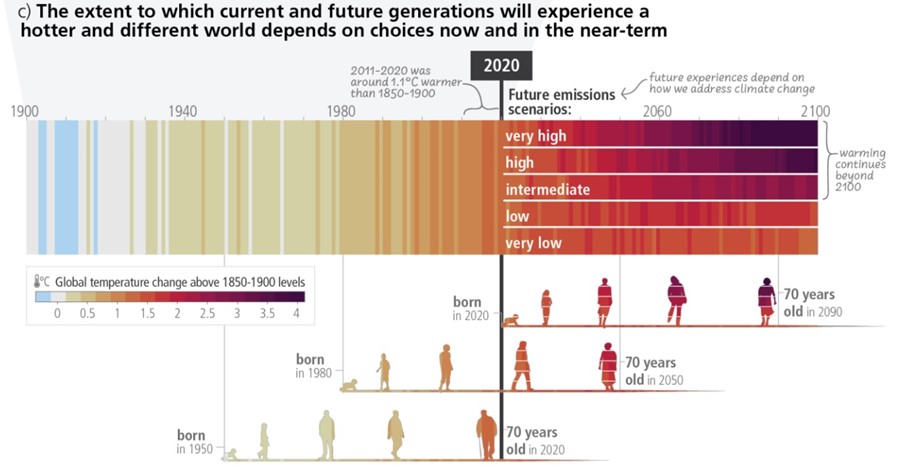
The chart above is the one that I think is most important for people to see. It came out in the latest IPPC report.
The climate stripes on the left-hand side represent our historic surface temperatures. These are the stripes we’re used to seeing presented, running from deep blue to red, but they’ve had to lighten the shade to reflect the severity of the future scenarios.
The right-hand stripes illustrate projected temperature rises to 2100 over five scenarios. The lowest bar is the ‘successful’ option, where we have slashed emissions by 50% within the next seven years.
The generational breakdown below the stripes represents (within a couple of years) my parents, me and my son. The best case for my son’s climate future is truly shocking in comparison to my parents, but each of the four worse cases are completely unconscionable.
For me, this chart is the most concise way of illustrating the urgency and importance of taking action to slash our carbon emissions now.
What have you done to move towards net zero?
The AimHi sessions are really well structured, with each of the four sessions having a clear theme, and we used each of these ‘hooks’ to link to a positive actions we were taking as an organisation and an invitation for staff to suggest further actions.
So, for instance, the first session on fossil fuels was where we announced our partnership with Make My Money Matter campaign to seek to reduce the fossil fuel investment in our pensions, and our implementation of the Climate Perks scheme to give employees additional leave to incorporate additional travel time associated with taking flight-free holidays.
The facts on pensions are terrifying:
For the session on global food systems we announced our adoption of a plant-based catering policy and that we are sharing ProVeg UK’s tips with our Eco-Schools to help schools across England lower their carbon footprints.
If we stopped all fossil fuel use now, our current food system would still result in us exceeding 1.5 and two degrees of warming, so it’s important that we act on this front too.
A plant-based food system halves the greenhouse gas emissions from food production and allows rewilding of 75% of agricultural land (an area equivalent to North and South America combined). As well as a massive biodiversity boost, rewilding would draw down between nine and 13 years of global carbon emissions.
Our internal events are now fully plant-based. Last year, for external events, we eliminated all red meat, required 50% of all menu options to be plant-based, and required plant-based milks to be served alongside cows’ milk. This year we are progressing to three quarters of meals to be plant-based.
The path to net zero can feel difficult, onerous or even costly. Does this work come cheap or free?
We paid for our training, and are paying for an Eco-Audit now, but the actions we have taken have all been free or cost-saving!
If you don’t know where to start it can feel challenging, but there is lots of amazing support out there that makes it easy (see the resources list below).
Could you tell us about the pensions changes and how that work is evolving?
Like lots of charities, we have two types of pension – a defined benefit scheme (now closed to new entrants) and a defined contribution scheme.
We looked at the defined contribution scheme first. After finding a net zero provider (Cushon), we asked our staff if they would like to switch. Some staff were keen, and others wanted to stay with their current provider, so we run both schemes side by side.
Over the year and a bit that we have run the net zero option, more staff have switched and newer staff are proving more likely to join the net zero option. Over a third of our combined pension contributions are now flowing to the net zero scheme.
For our old defined benefit scheme, the pension trustees use Legal & General Investment Management. When I attended their meetings, I raised the carbon footprint of their investments with them. It was a new conversation for them and they initially came back to say that they couldn’t improve the carbon footprint.
When I went to look at Cushon's underlying investments, the majority were held through LGIM, so sharing that data back enabled LGIM to make a significant cut in footprint without changing our risk/reward exposure.
In March 2022, the pension trustees incorporated a specific ESG objective as part of their investment strategy. Through a combination of LGIM’s decarbonisation changes and the trustees moving to lower carbon options, the growth assets the scheme uses are now around half the carbon footprint as in 2019.
Our scheme was the first of LGIM’s fiduciary management clients to implement ESG objectives. LGIM are developing their carbon reporting tools and it is interesting to discover that risk is currently correlated with higher footprints.
There is an interesting environmental incentive for organisations to pay their pension deficits down faster, enabling a switch to lower risk and therefore lower carbon investments.
As credit (if carefully constructed) is less carbon intensive than growth assets, the overall carbon footprint of the portfolio will reduce over time as the deficit is reduced as the scheme moves from growth assets to bonds.
Talking about the environmental impact alongside the investments has become normalised within a couple of years. If the first conversation feels awkward, relax in the knowledge that after a couple it will just feel run of the mill.
Did you experience any pushback from staff on any area of work?
After the AimHi session on the food system we announced all events would be 100% plant-based. There were differing opinions! We agreed a phased implementation for external events.
For us, it’s a really important space to share positive actions we can take – most of our events are held for local authorities. Most have declared climate emergencies and have targets for carbon reduction. Food system change is essential for a safe future for us all, and menu changes are an easy, zero-cost intervention local authorities can take, internally, and through schools in their LEAs.
As we increase the proportion of plant-based menu options we’ll be sharing posters about the positive environmental impact. When our Board meetings went plant-based there was some gentle surprise but at our strategy away day last month the Thai bento boxes and doughnuts left everyone feeling very cheery indeed. It’s about showing plant-based is about deliciousness rather than denial, and giving venues a helping hand to develop their own low-carbon menus.
How receptive has the Board been? And where will you go next?
Our Board set and hold our vision. They have identified the climate and biodiversity crises as two key pillars of the context in which we need to work, and in which our new five-year strategy is being developed. They have seen and understood this chart, and they know that this five-year strategy period is the critical time to act – for all of us.
The Eco-Audit we have underway at the moment goes beyond a standard organisational carbon footprint and includes consultancy on how we can best act to drive forward our charitable objects, which necessitate tackling the climate and biodiversity crises.
The findings will feed into our five-year strategy at this crucial point. We know from the chart that all five-year strategies now are crucial five-year strategies.
Are you having to tackle issues around reputation management? What are the risks, if any, of going further down the net zero path?
Keep Britain Tidy signed up to support The Big One – Extinction Rebellion’s non-violent, four-day protest outside Parliament in April. There was a little pushback on our social media about whether this was something we should be doing.
But pushing for a safe climate for all of us in a non-violent way is really not that radical, but rather essential – whatever area you work in. It was interesting that alongside Friends of the Earth and Greenpeace were also the Fairtrade Foundation, Tearfund, War on Want, CAFOD and hundreds more.
There isn’t a charity unaffected by the consequences of the climate crisis. Whoever we support, we all need safe food and water supplies to do that work.
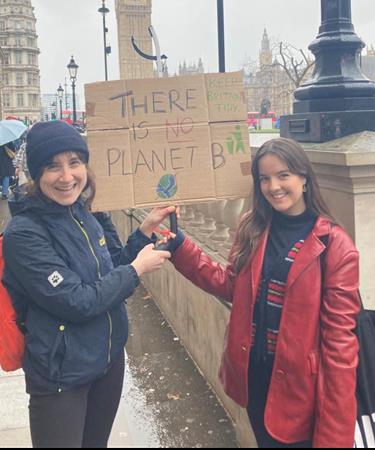
Alice Bonifacio and Emily Beadle from Keep Britain Tidy join XR's The Big One in April 2023
What can the sector do to educate others? Does it have a responsibility to?
All of us have a responsibility to act on this, across all fronts, and now. Criticism from those sceptical of climate change is irrelevant in light of the threat to life from the climate crisis.
UNICEF state one billion children are at ‘extremely high risk’ of the impacts of the climate crisis. If we are failing to address the climate crisis as organisations, we are, by definition, failing our beneficiaries.
What are the ‘quick wins’ you’d like to share with others? And how impactful are they?
- Offer your staff the choice of a net-zero pension scheme. Low effort, massive impact.
- Review your bank. Switching current accounts can be arduous, but switching investment accounts is much easier. Make sure your bank knows your views and if you switch tell them why.
- Green your travel policies – cut flights for work and support employees to cut flights for leisure through schemes like Climate Perks. Introduce carbon budgets for travel.
- Tackle food. You might have a big impact if you regularly cater, but even if it’s just your staff group it will have an important ripple effect.
- Look beyond your charity’s direct footprint to the wider influence you have. Get an Eco-Audit to help with that (that goes beyond an organisational carbon-footprint).
Finally, what advice would you give to charities looking to follow in your footsteps?
It takes courage to raise this in meetings where there doesn’t seem to be the space for it. But the scale of damage we are risking for ourselves and our children makes speaking up a necessity. You just need five minutes to talk them through the graph.
Then acting now becomes possible. It doesn’t matter if your voice shakes – it’s using your voice that’s essential.
Many thanks for your time, Ruth!
* (Average UK pension pot is £87,947) x (FTSE 100 CO2e emissions of 480m tonnes / £1.8 trillion market cap = 0.265 tonnes per £1,000 market cap) = equivalent of 23.3 tonnes of CO2 emissions per pension pot