CFG’s 2026 Annual Conference opened and closed with two inspirational speakers – Hetti Barkworth-Nanton CBE, CEO of Ploughshare and Chair of Refuge, and Lord Victor Adebowale CBE, former CEO of Turning Point and current Chair of the NHS Confederation. Together they explained how finance professionals are key to change and progress.

On one of the hottest days of the year, conference attendees make the most of the venue's air conditioning.
More than 650 finance professionals were treated to more than 30 thought-provoking sessions at CFG’s 2026 Annual Conference on 25 June. This year's theme – Empowering Change, Inspiring Progress – gave plenty of food for thought throughout the day, which opened with a fireside chat with Hetti Barkworth-Nanton CBE, and closed with a provocative speech from Lord Victor Adebowale CBE.
It’s about the people
Drawing on her 30-year career which has involved leading transformational change in both the private and third sectors, Barkworth-Nanton shared her lessons about making change happen.
A finance graduate who began her working life as a financial controller, Barkworth-Nanton credited her early career as good grounding for her leadership roles. The most rounded leaders she has met, she said, understand the “guts” of an organisation, from the numbers up.
Her message was that empowering change is ultimately about the people. Talking to CFG’s Co-CEO Sarah Lomax, Barkworth-Nanton stated that employees want three things from a leader: a vision they have helped to build, someone they can trust to have their backs, and then to be left to get on with it.
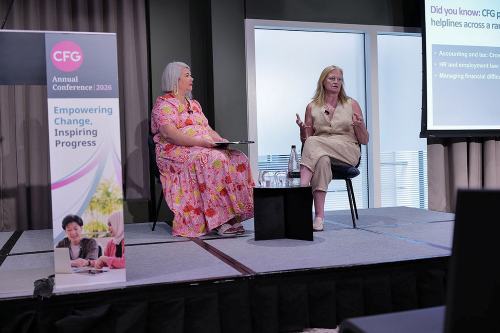
CFG's Co-CEO Sarah Lomax talks to Hetti Barkworth-Nanton CBE about leadership.
“What people want, frankly, is for leaders to get the hell out of the way, and empower them and let them get on with it,” she said. “Because if their heart is there, then they're going to do their very best every day, because they believe in it and they want to do a great job.”
Barkworth-Nanton explained that in her role it was her instinct to be “a shock absorber”, adding: “I'm there to protect my team from the nonsense that can distract from the brilliant work that we do.”
It sounds simple enough, but it was a lesson that took her time to learn: “In the early days I was doing technology change, and I thought it was about technology. It's not about the technology, stupid. It's about the people. If we anchor everything in the people, and we listen and we engage, and we then get the hell out of the way, then the world's your oyster.”
You are the front line
Closing the conference, Lord Victor Adebowale CBE took the day’s theme and Barkworth-Nanton’s leadership message further still, stating that true empowerment is not enabling or supporting or “giving people a voice”; it is a transfer of power from one set of hands to another.
He argued that in most charities that power sits in the finance office, because power is only ever three things – control over money, the authority to make decisions, and who carries or refuses risk. That, Lord Victor argued, makes finance professionals not the back office of change, but its front line.
“A budget is probably the most honest document any organisation ever produces,” he said. “Your mission statement tells me what you'd like to believe about yourself. Your budget tells me what you actually believe.”
For Adebowale, the language of stewardship is often the language of control. “We call it prudent. We call it good governance or data protection, or the system won't allow it. Sometimes those things are real and right. And sometimes they're simply the respectable words we use for keeping control at the centre.”
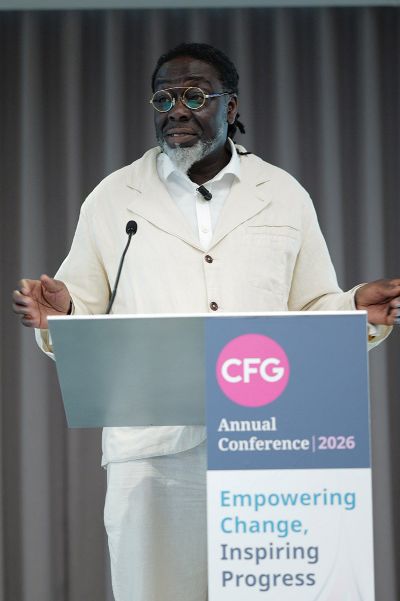
Victor Olufemi Adebowale, Baron Adebowale, CBE talks about the power of finance.
Part of Lord Victor’s speech was aimed squarely at funders. Unrestricted, flexible funding, he said, is worth fighting for because “the more restricted the pound, the less power travels with it”. Grantmakers should think in years, not months, he added: “You cannot ask people to take the long view of a problem while you make them re-justify their existence every March.”
His verdict and message to the finance professionals (and grantmakers) in the room: “Be braver, not safer. You are not the guardians of the sector's caution. You are the engine of its courage.”
You’ve got the power – pass it on
Although very different on the face of it, the opening and closing plenaries pointed to one important truth – finance holds power.
As Barkworth-Nanton said, finance professionals understand the bones of an organisation and are instrumental in shaping the vision and its delivery. As Lord Victor pointed out, finance decides how and where a pound travels, whether a decision waits three layers up, and whether the people closest to the problem are trusted to solve it.
Finance is not the charity sector's back office, nor its brake. It is the mechanism, in Lord Victor's words, “by which empowerment stops being a word and starts being a fact”.
It’s time to recognise that power one budget line, one system, one good decision at a time. The question is – will you pass on it, or pass it on?