Ben Clarkson, Chief Operating Officer at Asthma + Lung UK, explains what it takes to lead a successful merger of two charities and the lessons he’s learned along the way.

Picture the scene…
You’re just about to start your dream executive job at an £8m health charity. You’re preparing your handover in your current post while thinking about your new responsibilities, teams and systems …
From out of the blue, you get a call from your soon-to-be chief executive.
“Are you sitting down?” she asks.
“There might be a merger.”
These two phrases alone are enough to strike fear into any heart. And it was no different for Ben Clarkson.
Clear vision
In spring 2019, Ben accepted the role of Chief Operating Officer at Asthma UK. He didn’t know it at the time, but he would soon be opening a new chapter in the charity’s 92-year history.
“I was in an office at my old work place when my new chief executive phoned to tell me the news. The job I was waiting to start would likely mean merging Asthma UK and British Lung Foundation. I knew I was already stepping up into a bigger job. I was terrified.”
Doubting his ability less than his sanity, Ben “dived in”. The vision was clear. The charities were of a similar size and financially stable, they had cross-over beneficiaries, and both were looking to influence the same people. But, like many charities of that size with little or no local footprint, they were facing an uncertain future.
Ben explains: “Although technically Asthma UK was absorbed into British Lung Foundation, this was a merger of equals. It was an opportunity to speak with one unified voice for the one in every five people who will have a lung condition in their lifetime.
"And we could be more financially resilient by saving costs and be a bigger boat in stormy seas. I could see from the start that it made sense.”
Speed is of the essence
Although the phone call came out of the blue, the plan to merge didn’t. Ben had already had conversations about the likelihood of a merger during his final interview and knew that it was a possibility, even if only a hypothetical one.
But now it was really happening.
On his second day in the job, in September 2019, the merger proposal was agreed in principle and on 1 January 2020 the two charities became one, to form the Asthma UK and British Lung Foundation Partnership.
It was a temporary name, but the start of a permanent, single entity… And a year that saw a global crisis like no other.
As Covid-19 spread around the world, Ben and the teams were getting to work. The merged organisation had two headquarters so the decision was quickly made to move into one.
A new, modern telephony system replaced five separate systems that operated across two headquarters and three regional offices, and long lists of suppliers were scrutinised and consolidated.
Ben explains: “We focused on taking down the symbols and totem poles of each legacy charity from the start. From day one, we made sure everyone had the same new email address and access to all relevant files. We took down signs in offices and started to work on an integration programme to bring the organisations together.
“We made the conscious decision to do this at speed, in large part because of the cultural side – the sooner you can give people certainty, the better. Our approach was ‘done is better than perfect’ and so we deliberately left the big things off the table, like a new CRM and website.”
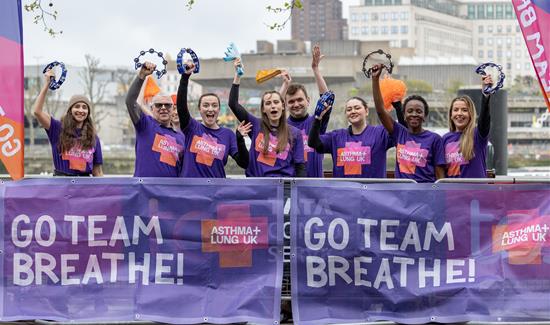
Asthma + Lung UK staff cheer on marathon runners.
Legal and technical hurdles
Of course, it wasn’t all plain sailing. The technical aspects of merging a single condition charity with a multiple condition charity with restricted and unrestricted funds was hard to navigate.
“There were a couple of days when I thought the merger wasn’t going to happen," recalls Ben. "This was an unusual merger in that we didn’t align objects, and because we kept two outward facing charity brands we were still asking people for money for Asthma UK – a single condition charity, which the British Lung Foundation wasn’t.
"This meant we had some additional complexities to sort through.”
Ben sought the advice of their auditors, Crowe UK, and following conversations with the trustees, Ben worked on a new restricted fund for asthma, to which new donations to Asthma UK were given. This fund would exist from the point of merger.
He also created a mechanism to apportion common costs, as well as attributing direct asthma spend. “It wasn’t perfect or easy," admits Ben, "but without this approach, the merger simply wouldn’t have happened."
The team also got to work on bringing together two very different finance systems and approaches. He continues: “On the first day of the new financial year, six months after the merger, we switched to one upgraded system and took down the other. We wiped away the old and came up with something new.
“This meant we had less than six months to completely redesign our chart of accounts, merge policies and so on. We really struggled with reporting up to that point due to some technical problems with one of the old systems; it wasn’t easy for the team.
"But we remained focused on building something new, something better. Getting just half way to where we wanted to be was still progress, so that’s what we focused on.”
The pandemic inevitably led to new challenges too. Staff had to be redeployed to the frontline to cope with an upsurge in demand for the helpline and health advice.
Ben explains: "Our helpline was being overwhelmed by demand, with peak daily calls reaching 5,000, and during the evening government briefings, a name-check from the prime minister crashed our website."
But there was an up-side: “Temporarily redeploying members of staff, and bringing them together in response to that demand, accelerated the cultural merger," says Ben.
"It took people to where we wanted to be, rather than to where we had been. It renewed our sense of purpose and united us. It’s true to say that there’s nothing quite like a crisis to bring people together.”
It also meant that redundancies could be minimised, and fewer people were furloughed. And, says Ben, this led to more positive feelings among staff who felt looked after.

Three years on…
It took 12-18 months to complete most of the post-merger integration, but the organisation quickly felt like one entity. According to Ben, staff engagement scores remained consistently high and cost savings were quickly realised, and with very few redundancies.
In April 2023, Asthma + Lung UK launched its new single website, which replaced three, and rolled out its new CRM – the final big pieces in the merger puzzle, and the culmination of an enormous team effort and many hours of hard work.
Reflecting on the experience, Ben concludes: “There will be times where it feels like it’s all about to go wrong.
"I remember one day, when I should have been at a conference, I was locked in the chief executive’s office making dozens of urgent phone calls trying to resolve a potential showstopper. I couldn’t see a way through, I thought it was all over.”
This is where support and advice from external organisations can prove invaluable. Ben explains: “In that situation, it needs somebody with a calm head who will tell you we’ll work it out and provide reassurance to the leadership team and trustees."
Ben says the team was fortunate to work with Pesh Framjee and Naziar Hashemi from Crowe UK, and Judith Miller from Sayer Vincent, all of whom provided reassurance to staff and trustees at just at the right moments.
“And that’s what it takes to see through a successful merger – determination, and someone to occasionally remind you that you all really believe in what you’re doing, and that you’re going to make it happen, so just keep going.
“And we did make it happen, very quickly. It was absolutely worth it.”
Ben Clarkson will be speaking at this year’s in-person CFG Annual Conference: Survive to Thrive. The event is now fully booked but you can still join us online for Annual Conference Week when we'll be running a range of exciting sessions. Find out more!
With thanks to Ben and the team at Asthma + Lung UK for sharing their story.