How can your charity finance team become truly transformational? What does that even look like? Emma Abbott takes a look at CFG's flagship development tool, The Finance Journey, to find out how it is being used to develop the charity sector's future finance leaders.
As we head into a new financial year, you might be thinking about the learning and development of your team, as well your own. What’s the best place to start? And how can we develop finance professionals at all levels to create a better future?
At the end of 2021, CFG launched a fully revised edition of 'The Finance Journey', dubbed, by its authors, as The Finance Journey 2.0. It was originally the brainchild of charity CFO Simon Hopkins who saw the enormous potential for charity finance professionals and teams to transform their organisations and increase their impact.
Simon explains: “The finance professional is critical in making sure that we create sustainable social businesses. We do that not for reasons of technical purity, but because we understand the direct link between organisational health and genuine social change...
"If I had a magic wand, I would eradicate poverty, racism, gender and health inequalities and so much more at a stroke. But we have to be prepared for the long game and we are absolutely central to that as a profession.”
Where did The Finance Journey begin?
It began with the notion that, with a dedicated professional and personal development tool, finance professionals could connect more meaningfully with their organisation’s purpose and become empowering, transformational leaders.
Simon explains: “The Finance Journey is targeted at charity finance professionals and is designed to help them make the transition from the ‘back office’ stereotype into redefining finance as a platform for strategic organisational leadership.”
Context, as ever, is key. Simon’s original version of 'The Finance Journey' was a classic case of necessity being the mother of invention. In 2008, he was working in the public sector against a backdrop of the need for finance to be a more central element of strategy, organisational development and transformational change, and not just an administrative overhead.
When Simon moved into the charity sector, he brought this understanding with him – along with some potential solutions. Simon continues: “We’ve all seen the same demands in the charity sector in recent years, but we can’t just say to colleagues ‘reinvent yourselves as strategic leaders and not just administrators or technicians’.
“As long ago as 2012, Caron Bradshaw OBE [CEO, CFG] and I recognised that we have to give people tools to embark on their own professional journey with confidence. That is why this model was deliberately entitled The Finance Journey.”
What does the model look like?
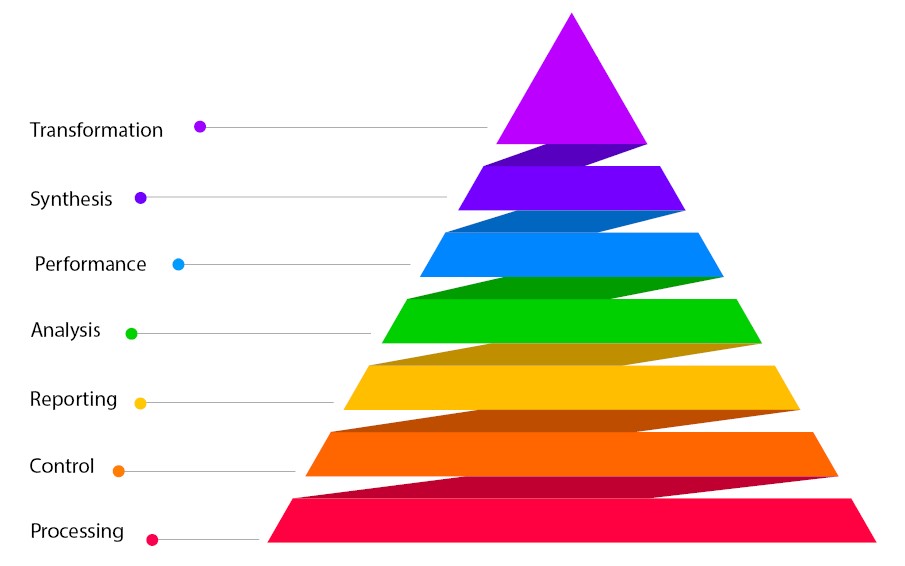
The model contains a set of techniques and approaches to help charity finance professionals operate at an ever more transformational level. It identifies seven levels of contribution that finance can make to any organisation.
A central premise is that these levels are acquired or mastered cumulatively. Therefore, in order to be truly effective at those areas that provide strategic leadership or insight, the technical stuff needs to be mastered first.
The model deliberately describes a progression – or journey – through several levels or stages of performance or activity.
Similarly, the model works only when finance continues to focus on the traditional responsibilities like control and reporting, as well as operating in the strategic and transformational space.
Below is the original model, although it can be graphically depicted in a variety of ways and has been adapted by different users.
The early adopters and adapters
Since the launch of the first edition, 'The Finance Journey' has been used by a diverse group of organisations. It has also become a consistent thread running through CFG’s Inspiring Financial Leadership programme. The feedback from many of these early adopters has since led to the development of the second edition.
Among others, the second edition has been co-authored by Judith Miller and Maggie Smith (co-founders of CFG’s Inspiring Financial Leadership course), Pete Knight, Executive Director of Finance and Commercial at Kidney Research UK, and Dan Haigh, Director of Finance & Information at St Richard’s Hospice.
Recalling the start of his personal Finance Journey, Pete Knight says: “From the moment I encountered The Finance Journey on module one of CFG’s excellent Inspiring Financial Leadership (IFL) course in October 2017, I was captivated by it.
“Here was a tool that could be simultaneously used to assess potential for organisations, create change programmes for finance functions, create personal development plans for individuals and, ultimately, facilitate leadership from finance rather than merely leadership of finance.”
Pete introduced the first edition of The Finance Journey to the Varkey Foundation, where he worked at the time, and it soon travelled to Argentina, Ghana and Uganda. The finance teams in those countries ran with it and developed their own skills – and the model itself – further.
Dan Haigh from St Richard’s Hospice had a similar experience to Pete, but he applied 'The Finance Journey' in a very different context.
Dan was looking for a way to encourage his small finance team to “change how they viewed their future from simply not making mistakes and maintaining the status quo to a future view that contained both organisational and personal development.
“It gave me a structured concept to enable me to coherently articulate what the future should look like.”
Like Pete, he saw the potential of 'The Finance Journey' as a personal and team development tool, but also as a way to articulate the team's development.
Responding to CFG's invitation to smaller charities to feed back on their user-experience, Dan set out to thoroughly test the model. He explains: “I started a Master’s programme with Bayes Business School and my dissertation attempted to answer the following question: ‘How good is The Finance Journey model in judging the strength of a hospice’s finance function in the view of key stakeholders?’.
The conclusion?
“The work done through my dissertation led me to conclude that 'The Finance Journey' model is valid for hospices. And once that was confirmed, this encouraged me to develop the model by creating a variation on The Finance Journey theme.”
It’s the model’s adaptability and universality that makes it such a powerful development tool for finance teams, not only in the UK, but potentially right around the world. Charities large and small can benefit from the model, and it doesn't matter where in the world they are based.
Simon Hopkins concludes: “We've launched this second edition at a time when we know many charity finance leaders are looking at how they can hone their own skills whilst supporting their teams to become ever more transformational.
"Inspiring and supporting finance professionals at all levels is vital to our future impact and this can only benefit the communities we work for. As ever, we invite you to start your own Finance Journey and share with us how you get on. I hope that you will find it useful.”
As a CFG member, access to The Finance Journey is available to you without charge, as one of your membership benefits. If you'd like to find out more about starting your own Finance Journey, please drop us an email and we'll get back to you. Download The Finance Journey 2.0 below...
Start your Finance Journey today!