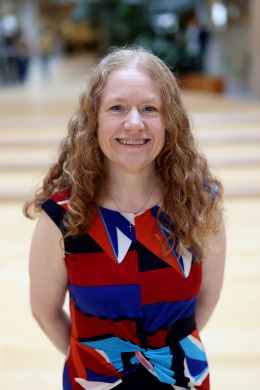
At this year's CFG Annual Conference, Sarah Fletcher, Chief Operating Officer at Alder Hey Children's Charity, led a session titled ‘Why putting people at the heart of strategy supports organisational growth and sustainability’. Her simple message was that the charities that invest in their people don't just do right by their staff, they grow faster, raise more, and become more resilient in the process.
Across the sector, small and medium-sized charities are grappling with the same pressures: rising demand, tight budgets, burnout, and a recruitment market where every organisation is fishing from the same shrinking pool. The instinctive response, as Sarah put it, is often to “ask people to do more”. Alder Hey decided to ask a different question: how do we help people perform sustainably?
From staff charter to strategy
Alder Hey's journey started with something deceptively simple: a staff charter. The charter sets out a series of shared commitments including that it's okay to flex working hours around home life, to protect time for exercise, to say a workload is full, to talk openly about mental health, and to ask questions of senior leaders without fear.
What's notable is how this thinking was then built directly into strategy, rather than being left to sit alongside it. Alder Hey's strategic objectives, including "Championing People, Wellbeing & Culture", sit as a named priority next to income growth and stewardship.
As Sarah said, they believed that “putting people at the heart of strategy” would increase retention, improve wellbeing, increase productivity and improve recruitment, but also “increase sustainable growth”.
"Putting people first” she explained, “did not mean lowering expectations”, adding “we didn’t believe investing in our people would detract from our bottom line, but rather grow it”.
The four-day week, without the caveats
The most notable part of Alder Hey's story is its move to a four-day working week, with no reduction in pay. Alder Hey took part in a nine-month four-day week trial, as part of the UK’s national pilot programme. They applied the well-known 100:80:100 model (100% of pay, for 80% of the time, in exchange for a commitment to maintain 100% of output), and committed to a 30 hour work week, with a Friday shutdown. The trial was built around clear KPIs, including income and productivity measures, alongside regular staff surveys and leadership review, rather than being introduced on faith alone.
The results, as presented in the session, were striking: increased income, increased productivity, improved staff retention, reduced sickness absence, stronger recruitment, and more creativity within teams.
Charity income rose from £4.7m in 2019/20 to £9.5m in 2024/25 (a 102% increase), a period that encompasses the culture shift Alder Hey was building, of which the four-day week was one part. When they started the pilot, they had not envisioned such positive results, with Sarah noting: “we actually thought that we would be lower in income than the previous year”, so seeing the income increase was a pleasant surprise.
The thing they were “most surprised about”, Sarah explained, was “that real spark of creativity”, that the new working pattern generated within the team. She highlighted how people were coming back from their long weekends more refreshed, and “we could really see that spark in people, which was fabulous”.
The charity has since been recognised in the Sunday Times Best Places to Work 2026 list for small organisations, with excellent scores across confidence in management, wellbeing risk, flight risk, and workplace engagement.
Sarah was candid about the concerns that come with a move like this. Questions around productivity and delivery, fairness, supporter expectations, and board risk appetite are all valid. What made the difference, in her reflection, was that changing working practices had to be genuine, leaders needed to visibly model the new approach themselves, and staff needed real confidence that the change was permanent rather than a trial that would be reversed.
Alder Hey isn't alone
What's striking is that Alder Hey's experience isn't unique. It echoes a growing body of evidence from across the charity and non-profit sector.
The most recent UK-wide four-day week pilot, which took place in 2025, involved 17 organisations and nearly 1,000 workers. It was hailed as a 100% success: every single participating organisation chose to continue with a shorter working week after the trial ended, with several having already made the change permanent. Eight of the 17 were charities, not-for-profits or NGOs, including Bioregional, Bron Afon Community Housing and Global Witness. Bioregional's chief executive reported that revenue stayed broadly flat while staff wellbeing and job satisfaction improved significantly enough that the charity chose to extend its trial.
The Mental Health Foundation offers one of the clearest examples of the retention and recruitment case for shorter hours. After a year-long pilot of a 32-hour week, the charity made the change permanent, reporting that close to eight in ten staff experienced better work-life balance, over two-thirds saw improved mental wellbeing, and more than two-thirds reported reduced work-related stress. Just as significantly for a sector often worried about recruitment, the average number of applications per role nearly doubled during the pilot, and almost three in ten applicants cited the shorter week itself, not salary, as the reason they applied.
Charity Bank, another pilot participant, reported similar gains in staff morale and employer brand, with its chief executive describing the shift as "amazingly successful" for the majority of the team, even while acknowledging it wasn't a universal fit for every role. Across all these trials, organisations adapted the model to their own operations, from full closures on the same day each week to staggered rotas and decentralised, team-by-team approaches.
What this means for charities, regardless of size
Not every organisation has the resource to run a formal, monitored four-day week pilot, and Sarah was careful not to suggest this is a straightforward off-the-shelf fix. But the underlying lesson from Alder Hey's experience, and from the wider evidence, doesn't depend on charity size or budget.
Culture, explained Sarah, determines whether growth becomes sustainable or exhausting. A staff charter costs nothing to write. Leaders modelling boundaries around time, breaks and wellbeing costs nothing but intention. What changed for Alder Hey was viewing wellbeing as a vital part of what makes operational sustainability possible in the first place.
For a sector that so often runs on goodwill and long hours, the example of Alder Hey, and the growing body of evidence from across the sector, suggests the questions for charities isn’t whether they can afford to invest in their people, but whether they can afford not to.